 UML/SysML with TRAK
Class (Block) Diagram
Contents
Rationale and Underlying Metamodel
The OMG UML 2.5.1 specification, isn't the best in the language used around classifiers:
The core concept is Classifier, an abstract metaclass whose concrete subclasses are used to classify different kinds of values.
The primary Classifier element is the Class in the UML and the Block in the SysML.
A Classifier represents a classification of instances according to their Features. Classifiers are organized in hierarchies by Generalizations
A Classifier has a set of Features, some of which are Properties called the attributes of the Classifier.
A fundamental part of using Classes / Blocks is the ability to link related concepts and identify properties that differentiate a child Class / Block from its parent. This is achieved using specialization / generalization.
Generalizations define generalization/specialization relationships between Classifiers. Each Generalization relates a specific Classifier to a more general Classifier.
An instance of a Classifier is also an (indirect) instance of each of its generalizations. Any Constraints applying to instances of the generalizations also apply to instances of the Classifier.
A Classifier is a Type, and conforms to itself and to all of its generalizations.
The Class / Block will be an Architecture Description Element and therefore the triples involving Architecture Description Element will also apply to Class / Block. These are the 'Universal' triples that apply to any element on an architecture view.
In the TRAK metamodel Contract, Requirement and Standard may govern any Architecture Description Element hence also State and similarly in the reverse compliance or conformance direction using 'satisfies'. A Claim or Concern may be raised about any element and similarly an Argument in an assurance case may be linked to any element.
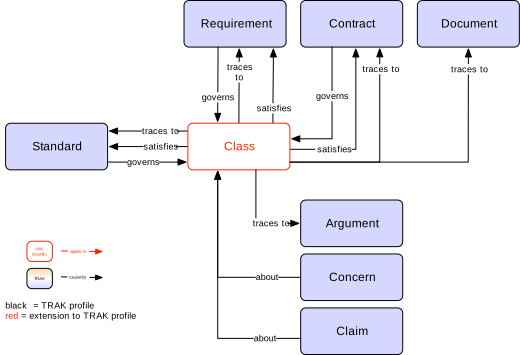
Elements and Connectors (Triples) - Linking Class / Block Diagram with TRAK Universal Elements
Example Class (Block) Diagram
TBA
Features
Bare Profile
UML
The UML-TRAK profile (this project) provides - Assembly, Auxilliary, Call, Class, Connector, Create, Delegate, Destroy, Enumeration, Focus, ImplementationClass, Instantiate, Interface, Part, Port, PrimitiveType, ProvidedInterface, Realization, RequiredInterface, Send, Signal, Specification, Type, Utility, aggregates, associates, AssociationClass, composes, generalizes, realizes
The TRAK (UML) profile from trakumlprofile provides Resource elements (Job, Organisation, Physical, Role, Software and System).
The TRAK (UML) profile also provides elements to create universal triples that may appear on any architecture view - Argument, Claim, Concern, Contract, Document, Standard, 'about', 'governs', 'satisfies' and 'traces to'.
SysML
TBA
MDG (Sparx Systems Enterprise Architect)
The MDG for Sparx EA uses the bare UML and SysML profiles and also other Sparx EA-only profiles that provide functionality and modify the user interface within Sparx EA.

Custom Toolbox Provides the Elements to Create UML Class Diagram
The MDG for Sparx EA when loaded provides:-
- customised toolbox palette adding
- QuickLink - auto-completion/creation of triples shown in the metamodel fragment
- custom traceability pane
- Class Diagram-related searches (in addition to c 60 searches provided by the MDG for TRAK)
- Repository - All Association Classes
- Repository - All Auxiliary Classes
- Repository - All Classes
- Repository - All Enumerated Values
- Repository - All Enumerations
- Repository - All Focus Classes
- Repository - All Implementation Classes
- Repository - All Interfaces - Provided and Required
- Repository - All Ports
- Repository - All Realization Classes
- Repository - All Signals
- Repository - All Specification Classes
- Repository - All Type Classes
- Repository - All Utility Classes
- Analysis - All Information Flows
- Analysis - Attributes with Enumerated Values
- Quality - Enumerations Not Linked to Classes
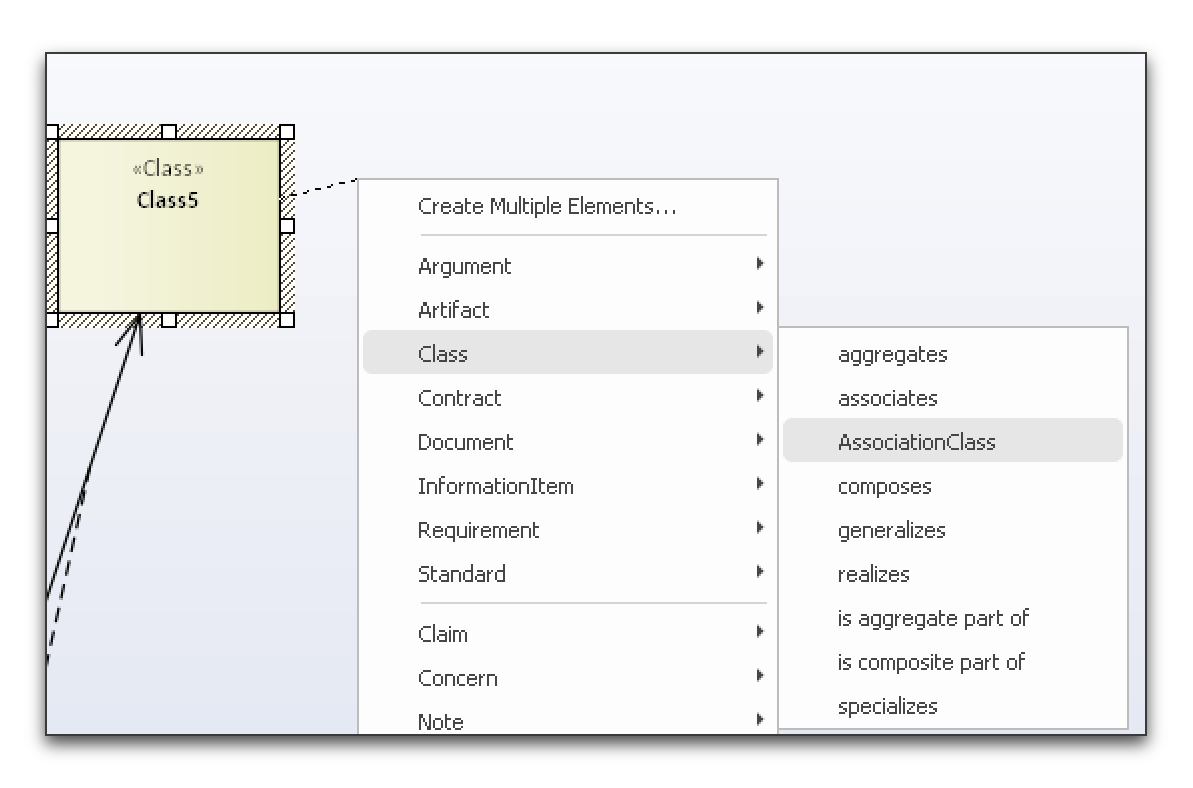
Quicklink - Suggests Relationships and Target Element Based on Selected Element Type
Other References
See also the TRAK SV-01 Solution Structure architecture view used to describe the structure of Resources.